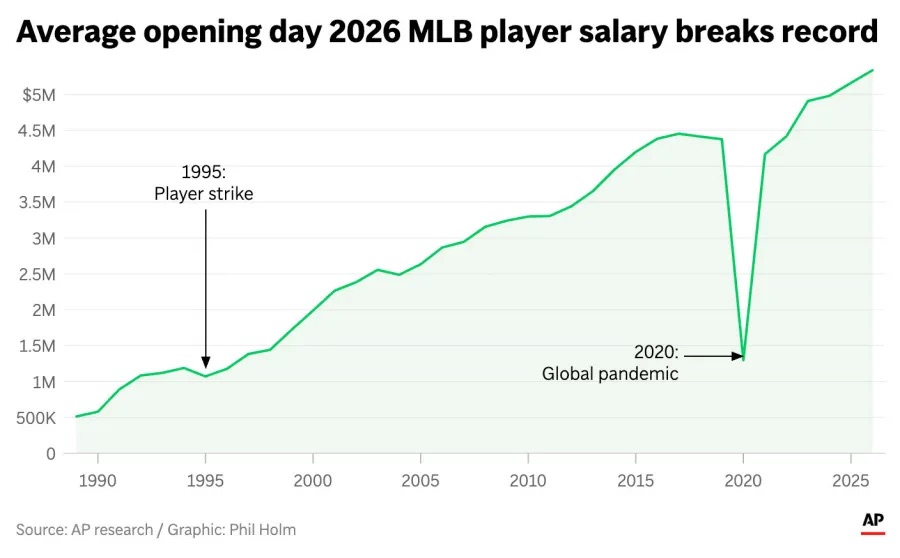
Major League Baseball average salaries reached a record $5.34 million on Opening Day, marking a 3.4% increase from last season, according to a study by The Associated Press. The New York Mets once again led league payroll spending, topping the list for the fourth consecutive year.
Mets outfielder Juan Soto ranked as the highest-paid player in Major League Baseball for the second straight season with earnings of $61.9 million. He was followed by New York Yankees outfielder Cody Bellinger, who earned $42.5 million. Philadelphia Phillies pitcher Zack Wheeler and Mets third baseman Bo Bichette tied for third at $42 million, while Toronto Blue Jays first baseman Vladimir Guerrero Jr. ranked fifth at $40.2 million, just ahead of Yankees star Aaron Judge at $40 million.
The Mets entered the season with a payroll of $352.2 million, slightly below their record-setting $355.4 million total from 2023 but significantly higher than last year’s $322.6 million. Their payroll is more than five times higher than that of the Cleveland Guardians, the league’s lowest-spending team at $62.3 million.
The two-time defending World Series champions, the Los Angeles Dodgers, ranked second in payroll at $316.6 million. Their total would rise to $395.2 million if deferred payment contracts were calculated at full future value. The Mets also use deferred-payment deals, though to a lesser extent, with their payroll potentially reaching $360 million without present-value adjustments.
MLB’s average salary of $5,335,966 increased from $5,160,245 at the start of last season and has grown by 28% since the current five-year collective bargaining agreement began. The top five payroll spenders remained unchanged from last year, with the Yankees ranking third at $297.2 million, followed by the Phillies at $282 million and the Blue Jays at $269 million.
Six teams entered the season with payrolls exceeding $250 million, up from four last year, while 10 teams surpassed $200 million, an increase from nine. Meanwhile, eight teams began the season with payrolls below $100 million, compared with five in the previous year.
The Detroit Tigers recorded the largest payroll increase, rising by $64.2 million to $206.7 million after acquiring pitcher Framber Valdez, re-signing Gleyber Torres, and awarding a significant arbitration raise to ace Tarik Skubal. The Atlanta Braves increased spending by $44.1 million, while the Chicago Cubs, Blue Jays, and Mets each boosted payroll by nearly $30 million.
In contrast, the Minnesota Twins made the largest payroll reduction, cutting spending by $46.3 million to $96.5 million. The St. Louis Cardinals also significantly reduced payroll, dropping from $141.5 million to $100.4 million after restructuring contracts involving players such as Nolan Arenado, Sonny Gray, and Willson Contreras. Other teams with notable payroll cuts included the Guardians, Texas Rangers, and Washington Nationals.
The payroll figures reflect the 942 players listed on Opening Day rosters and injured lists but exclude players on restricted lists and those assigned to minor league teams at the start of the season. Baseball’s median salary rose to $1.4 million from $1.35 million, though it remains below the record $1.65 million set in 2015.
Salary distribution data showed that 519 players, or about 55% of the league, earned $1 million or more. Nineteen players earned at least $30 million, an increase from last year, while 74 players made $20 million or more. Meanwhile, 31 players received the league minimum salary of $780,000.
The study also found that the league’s highest-paid players continue to command a growing share of overall salaries, with the top 50 players accounting for 30% of total earnings and the top 100 players earning nearly half of all MLB salaries. These figures highlight the widening financial gap between high-spending teams and lower-budget clubs across Major League Baseball.