Manchester United’s net debt has surpassed the $1 billion mark for the first time, driven by additional loans taken out to finance player signings during the summer transfer window. This has pushed the club’s total debt to its highest point since the Glazer family’s leveraged buyout in 2005.
The club’s latest first-quarter financial report, released on Thursday, showed non-current borrowings—stemming from the Glazers’ acquisition—at £481 million (approximately $644 million).
However, after drawing an extra £105 million from the revolving credit facility to support transfers, current borrowings rose to £268 million, bringing overall net debt to £749 million (about $1.002 billion).
The club has been managing this substantial debt burden ever since the Glazers, owners of the NFL’s Tampa Bay Buccaneers, purchased the then debt-free team two decades ago.
In February 2024, Sir Jim Ratcliffe’s INEOS Group acquired a 27.7% minority stake for £1.3 billion, becoming partial owners.
Since then, Ratcliffe and INEOS have implemented aggressive cost reductions at Old Trafford to improve the club’s long-term financial health.
Even with net debt crossing the $1 billion threshold for the first time, CEO Omar Berrada stated that the recent figures demonstrate “strong progress in our transformation of the club.”
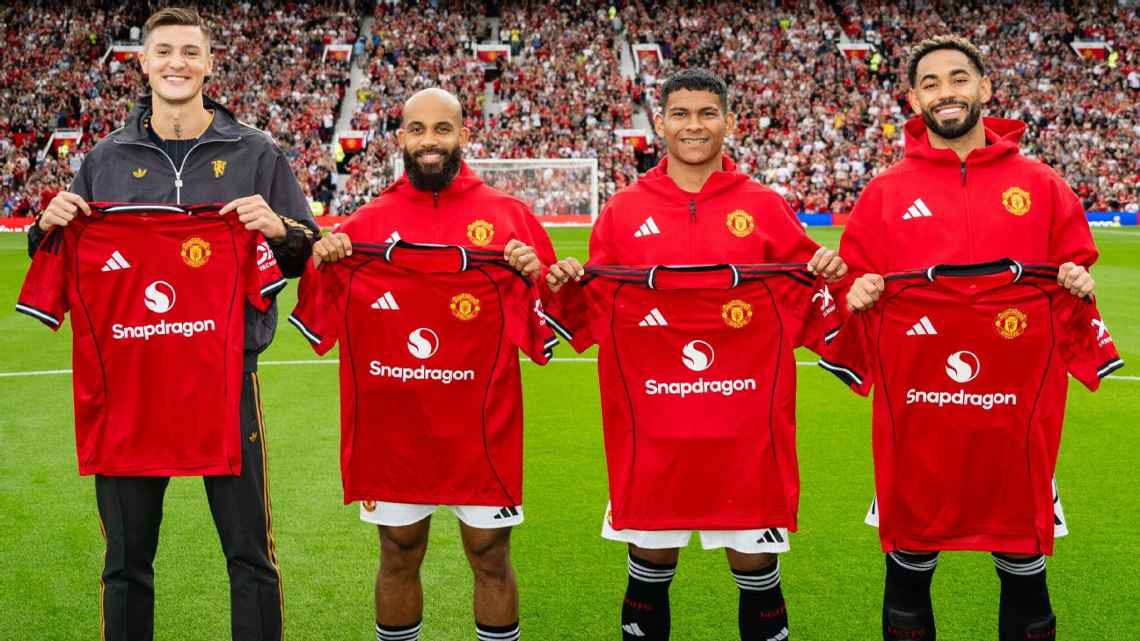
Manchester United had a busy summer, signing Benjamin Sesko and Matheus Cunha, among others.
Manchester United recorded a £13 million operating profit in the first quarter of the current season, a significant improvement from the £6.9 million loss reported in the same period the previous year, despite missing out on European football this term.
Total revenue for the quarter fell 2% to £140.3 million, primarily due to the men’s first team—currently sixth in the Premier League under manager Ruben Amorim—not participating in continental competitions. In contrast, the women’s team, led by Marc Skinner, are third in the Women’s Super League and are active in the Women’s Champions League.
CEO Omar Berrada described the results as robust, stating: “These strong financial outcomes demonstrate Manchester United’s resilience as we advance significantly in transforming the club. The tough choices made over the past year have created a more sustainable cost structure and a leaner, more efficient organisation better positioned to deliver enhanced on-pitch and commercial success in the long term.”
He added that these efficiencies have enabled continued investment in both the men’s and women’s squads, which occupy sixth and third places in their respective leagues.
The financial report highlighted ongoing benefits from cost-cutting and staff reduction initiatives introduced in the prior year. Under INEOS’s oversight, a large-scale redundancy programme—part of broader operational restructuring—contributed £8.6 million in exceptional costs for the first quarter of fiscal 2026.
Combined with lower player wage bills, these measures reduced employee benefit expenses by £6.6 million year-on-year to £73.6 million.
Sponsorship income declined 9.3% to £47 million, mainly due to the expiration of the training kit partnership with Tezos and the absence of a new deal in that category. Nevertheless, the club reaffirmed its full-year revenue guidance of £640 million to £660 million.